Thinking about moving to Texas but torn between Austin and Dallas? Both cities have strong economies and plenty of personality, but they feel very different day to day. Austin is smaller, more outdoorsy, and tech driven. Dallas is bigger, more corporate, and gives buyers more home for the money.
Key Insights for Austin vs. Dallas
- Home prices: Austin's median sale price is about $550,000, roughly $100,000 above Dallas at about $450,000 (Redfin, 2026).
- Rent: Rents are nearly identical. A one-bedroom runs $1,174 in Austin and $1,209 in Dallas (Apartment List, October 2026).
- Property tax: Dallas has the higher rate (1.66% versus 1.25%), but Austin's typical bill is larger because home values are higher.
- Jobs and income: Austin leads in tech, income, and unemployment (3.9% versus 4.4%). Dallas-Fort Worth is a much larger and more varied job market.
- Getting around: Dallas has the bigger transit network. Austin has the slightly shorter average commute.
- Outdoors: Austin has parks, lakes, and swimming holes inside the city. Dallas has strong trails and gardens but fewer water options nearby.
Below, we compare Austin and Dallas on housing, jobs, transportation, and lifestyle, using current data so you can see where each city comes out ahead. Whether you are deciding between the two or planning a move from Dallas to Austin, use this guide to match each city to your budget and priorities.
Austin vs. Dallas at a Glance
| Feature | Austin | Dallas |
|---|---|---|
| Median sale price (Redfin) | About $550,000 (3 months ending Aug 2026) | About $450,000 (3 months ending Sep 2026) |
| Median rent, 1-bedroom (Apartment List) | $1,174 | $1,209 |
| Median rent, 2-bedroom (Apartment List) | $1,429 | $1,432 |
| Median effective property tax rate | 1.25% | 1.66% |
| Median annual property tax bill | $7,479 | $4,489 |
| Median household income (Census, 2020-2024) | $93,658 | $70,518 |
| Average commute to work (Census, 2020-2024) | 23.7 minutes | 25.7 minutes |
| Metro unemployment rate (BLS, Aug 2026) | 3.9% | 4.4% |
| Metro population (Census, July 2025) | About 2.62 million | About 8.48 million |
Sources: Redfin Dallas, Hoodline (Redfin Austin figure), Apartment List Austin, Apartment List Dallas, Ownwell Austin, Ownwell Dallas, Census QuickFacts Austin, Census QuickFacts Dallas, BLS Austin, BLS Dallas, Census estimates via CityPopulation (Austin), Hoodline (Census, DFW). Home prices and rents are citywide. City figures use city limits, population uses the metro area. Last updated October 2026.
Population and Demographics
Population size and growth
Both metros keep growing. The Dallas-Fort Worth-Arlington metro had about 8.48 million residents as of July 2025 and added roughly 123,600 people in a single year. The Austin-Round Rock-San Marcos metro is much smaller at about 2.62 million, and the city of Austin itself is just over 1 million people, compared with about 1.33 million in the city of Dallas.
Because Dallas is counted as part of a much larger metro, compare city to city or metro to metro, not one against the other.
Age distribution
Both cities skew young. The Austin metro's median age is about 36 (Census ACS 2024), and the city of Austin is younger still at about 35. The University of Texas at Austin and the tech industry pull in a large share of residents in their 20s and 30s.
Cost of Living: Austin vs. Dallas
Your paycheck is only part of the equation. Here is how housing, rent, taxes, and everyday costs compare. For a deeper look, see our Austin cost of living guide.

Housing prices
Austin costs more to buy in. The median sale price was about $550,000 in the three months ending August 2026, compared with about $450,000 in Dallas for the three months ending September 2026 (Redfin). That is a gap of roughly $100,000.
The Census tells the same story over a longer window: the median value of owner-occupied homes was $555,300 in Austin and $320,700 in Dallas for 2020-2024. Austin prices have softened from their peak while Dallas prices have edged up, so the gap is narrower than it was a few years ago.
Price ranges vary a lot by neighborhood in both cities, so treat these as citywide medians rather than what you will pay in a specific area.
Investment potential
Both cities offer opportunities for growth and profitability. Austin's population growth and strong job market have historically appealed to investors seeking appreciation and rental demand, though recent price softening means returns are less certain than they once were. Dallas generally offers a lower entry price and more stability for long-term investors. If you are weighing investment options, see our guide to the best places to invest in Austin.
Related blogs:
- Best Places to Invest in Austin
- The Ultimate Guide to Investing in Austin Real Estate
- Different Types of Investment Properties in Austin
Rental costs
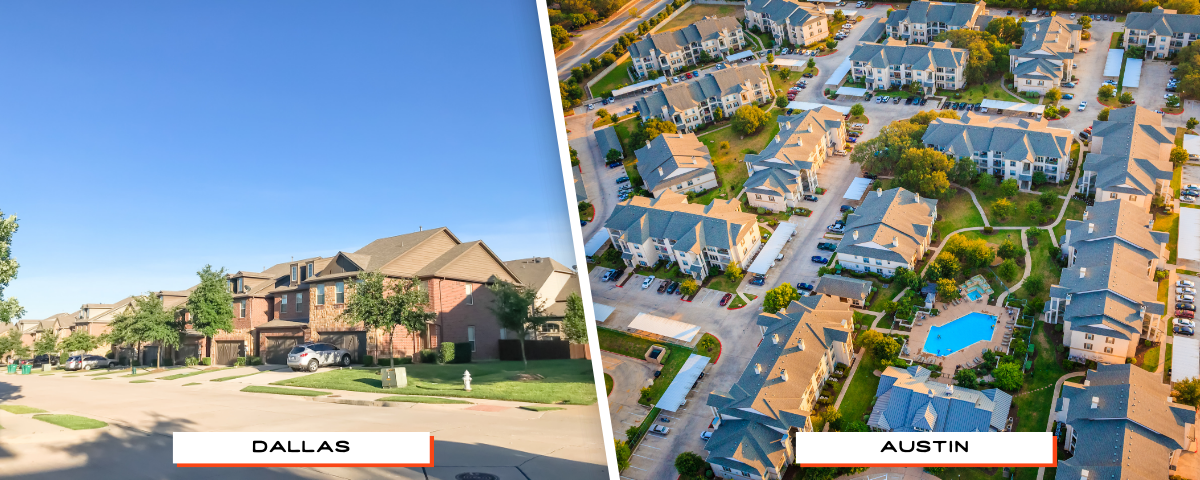
Renting costs about the same in either city. In October 2026, the median one-bedroom rent was $1,174 in Austin and $1,209 in Dallas, and the median two-bedroom was $1,429 in Austin and $1,432 in Dallas (Apartment List). Rents have eased in both cities over the past year, down 2.3% in Austin and 1.5% in Dallas.
Rent varies widely by neighborhood, so compare specific areas before you decide.
Property taxes
Texas has no state income tax, so property tax is a major part of your housing cost in both cities. Dallas has the higher median effective rate at 1.66%, compared with 1.25% in Austin. Austin's median annual bill is still larger, at $7,479 versus $4,489 in Dallas, because Austin homes are worth more.
Your actual rate depends on your exact address, since school districts, counties, and special districts each add their own levy.
Utilities and groceries
Day-to-day expenses are close in both cities. Some reports show slightly lower grocery costs in Dallas, but the difference is small and depends on where you shop and how you live.
Job Markets in Austin and Dallas
Both cities have strong job markets with different strengths. Austin is known for tech, while Dallas-Fort Worth spreads across finance, healthcare, telecommunications, and energy. In August 2026, the Austin metro's unemployment rate was 3.9% versus 4.4% for Dallas-Fort Worth (BLS, not seasonally adjusted, preliminary).

Austin
- Industries: Tech is the anchor, with many large companies running major offices in the Austin area.
- Major employers: Dell, IBM, and Apple all have significant operations in the area.
- Size: About 1.42 million nonfarm jobs in the metro (BLS, August 2026).
Dallas
- Industries: A broad mix of finance, healthcare, telecommunications, energy, and tech.
- Major employers: AT&T, American Airlines, and Texas Instruments are major names across the Dallas-Fort Worth area.
- Size: About 4.36 million nonfarm jobs in the metro (BLS, August 2026).
Austin is ideal for tech professionals. Dallas offers a broader range of opportunities across sectors. Our guide to Houston vs. Austin covers a third option.
Income and salaries
Austin households earn more. The median household income is $93,658 in Austin and $70,518 in Dallas (Census, 2020-2024, in 2024 dollars). Higher pay helps offset Austin's higher home prices, but it is worth running the numbers against your own salary.
Transportation and Commute Times
Nobody likes sitting in traffic, and both cities are car-centric. Here is how they compare.
| Feature | Austin | Dallas |
|---|---|---|
| Average commute (city) | 23.7 minutes | 25.7 minutes |
| Transit system | Capital Metro (bus and rail) | DART (bus, light rail, commuter rail) |
| Transit coverage | Smaller network | Larger network across the metro |
| Daily driving | Most residents drive | Most residents drive |
Commute source: Census QuickFacts (2020-2024). Transit coverage is a general comparison, not a measured figure.
Public transportation options
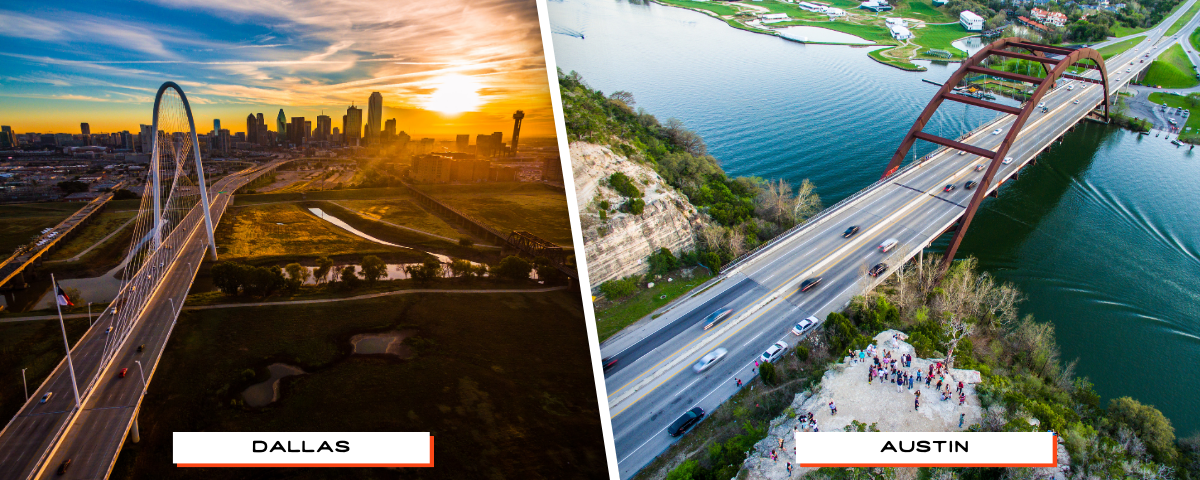
Dallas has the edge on transit. DART runs bus, light rail, and commuter rail across a large part of the metro, while Capital Metro serves a smaller network. Even so, you will likely want a car in either city, especially outside the center.
Traffic congestion
Traffic is a problem in both cities. Austin has dealt with congestion as its population has boomed, and Dallas is no better during rush hour. Neither city is winning awards for speedy commutes.
Average commute durations
Austin's average commute is slightly shorter. The city's average is 23.7 minutes, compared with 25.7 minutes in Dallas (Census, 2020-2024). Your own commute will depend heavily on where you live and work.
Outdoor Activities and Recreation
Parks and green spaces
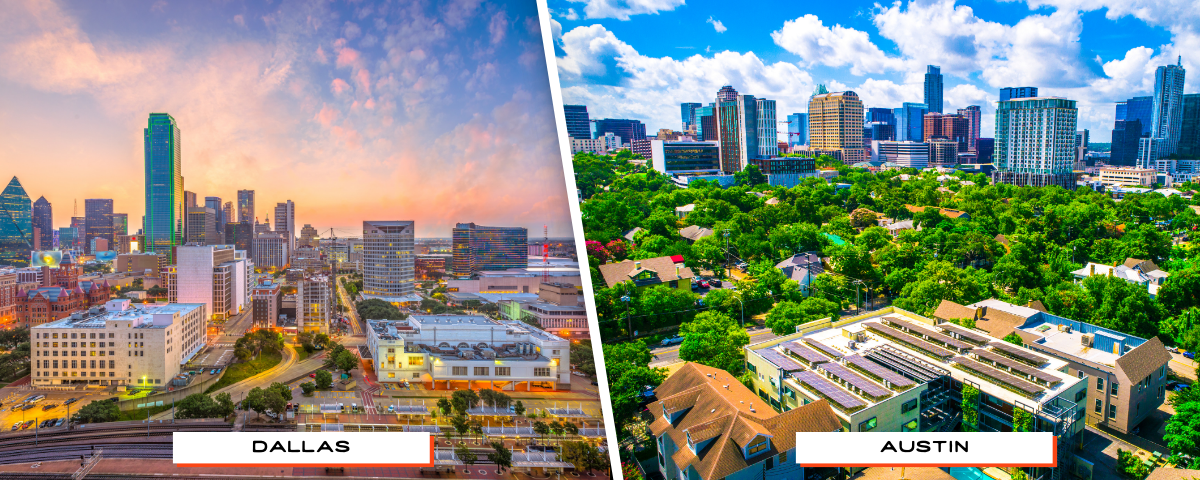
If you love nature, Austin is hard to beat. Zilker Park, the Lady Bird Lake Hike and Bike Trail, and the Barton Creek Greenbelt are all inside the city. Dallas has strong outdoor options too, including White Rock Lake Park, the Katy Trail, and the Dallas Arboretum.
- Austin: Zilker Park and Barton Springs Pool, Barton Creek Greenbelt trails, and Lady Bird Lake for kayaking, paddleboarding, and walking.
- Dallas: The Katy Trail for running and biking, White Rock Lake for walking, biking, and boating, and the Dallas Arboretum and Botanical Garden.
Water activities
Austin has a clear advantage. With swimming holes, lakes, and rivers close to the city center, you can swim, kayak, or paddleboard without driving far. Dallas has nearby lakes for boating and fishing, but they are generally a longer trip.
Food and Dining Scene
Both cities have standout food scenes. Austin is known for Tex-Mex, barbecue, and inventive local cooking at places like Uchi, Franklin Barbecue, and Odd Duck. Dallas has a deep lineup of high-end restaurants, such as Pappas Bros. Steakhouse, Uchi Dallas, and Petra and the Beast.

Food truck culture
Austin has a well-established food truck culture, with food truck parks and individual trucks across the city. Popular names include Veracruz All Natural, East Side King, and Valentina's Tex Mex BBQ. Dallas has a growing scene, but it is not as extensive as Austin's.
Music and Entertainment
Live music venues
Austin is known as the "Live Music Capital of the World," with live music venues ranging from small clubs to large outdoor amphitheaters. Iconic stops include the Continental Club, Stubb's BBQ, and the Moody Theater, home of Austin City Limits. Dallas has a lively scene too, with venues like the Granada Theater, Trees, and the House of Blues.

Festivals and events
Both cities host major events year-round. Austin is known for South by Southwest (SXSW) and the Austin City Limits Music Festival. Dallas hosts the State Fair of Texas, the Dallas International Film Festival, and the Taste of Dallas food festival.
Nightlife options
Both cities have plenty of nightlife, from bars and clubs to comedy and live music. Austin's Sixth Street is the classic bar-hopping destination, and Dallas has the Deep Ellum neighborhood, known for its mix of bars, clubs, and music venues.
Choosing the Right City for You
Factors to consider
When deciding between Austin and Dallas, weigh job opportunities, cost of living, transportation, safety, entertainment, and overall quality of life against your own priorities. There is no one-size-fits-all answer.
Pros and cons of each city
| Feature | Austin | Dallas |
|---|---|---|
| Overall feel | Laid-back, outdoorsy, tech and music driven | Big-city, corporate, polished |
| Home prices | Higher buy-in | About $100,000 lower at the median |
| Rent | Roughly the same as Dallas | Roughly the same as Austin |
| Job market | Tech-heavy, lower unemployment | Larger and more varied across industries |
| Getting around | Car-dependent, shorter average commute | More rail and bus coverage with DART |
| Outdoors and water | Lakes, springs, and greenbelt trails in town | Lakes and trails, but more spread out |
| Best for | Buyers wanting outdoor access, music, and a tech career | Buyers wanting more home for the money and career variety |
Austin: strong tech job market, a vibrant cultural scene, and abundant outdoor recreation. The tradeoffs are a higher purchase price and traffic congestion that has grown with the population.
Dallas: a diverse job market, more home for your money, and a wide range of dining and entertainment. The tradeoffs are a sprawling layout and heavy reliance on cars.
Ultimately, the right city depends on your priorities and lifestyle. If you are deciding whether to move to Austin from Dallas, our moving to Austin checklist will help you plan a smooth move.
Frequently Asked Questions
Is Austin more expensive than Dallas?
Yes for buying a home, and about the same for renting. Austin's median sale price was about $550,000 in the three months ending August 2026, compared with about $450,000 in Dallas for the three months ending September 2026 (Redfin). Median rent is close: $1,174 for a one-bedroom in Austin and $1,209 in Dallas (Apartment List, October 2026).
Is it cheaper to live in Dallas or Austin?
Dallas is cheaper if you plan to buy, because the median home costs roughly $100,000 less. Renters will find little difference. Austin's higher median household income ($93,658 versus $70,518 in Dallas, Census 2020-2024) offsets some of the gap.
Which city has higher property taxes, Austin or Dallas?
Dallas has the higher rate, but Austin's typical bill is larger. The median effective rate is 1.66% in Dallas and 1.25% in Austin, yet the median annual bill is $7,479 in Austin versus $4,489 in Dallas because Austin home values are higher (Ownwell, 2026). Texas has no state income tax in either city.
Which city has the better job market, Austin or Dallas?
It depends on your industry. Austin leads in tech and had a lower metro unemployment rate in August 2026 (3.9% versus 4.4% for Dallas-Fort Worth, BLS). Dallas-Fort Worth is much larger, with about 4.36 million nonfarm jobs versus about 1.42 million in Austin, and it spans finance, healthcare, telecommunications, and energy.
Which city has the shorter commute?
Austin, by a small margin. The average commute is 23.7 minutes in Austin and 25.7 minutes in Dallas (Census, 2020-2024). Both cities are car-dependent, and your actual commute depends heavily on where you live and work.
Is Austin or Dallas better for outdoor activities?
Austin. Zilker Park, the Barton Creek Greenbelt, Lady Bird Lake, and local swimming holes are all inside the city. Dallas has White Rock Lake, the Katy Trail, and the Dallas Arboretum, but water recreation is generally farther from the city center.
Should I move to Austin or Dallas?
Choose Austin if you want outdoor access, live music, and a tech career, and you can handle a higher purchase price. Choose Dallas if you want more home for your money and a wider range of employers. A local agent can compare specific neighborhoods and budgets for you.
Data notes: home prices are Redfin medians, rents are Apartment List October 2026, tax figures are Ownwell medians, income and commute are Census 2020-2024 city figures, and employment is BLS August 2026 (preliminary). Figures change monthly. Last updated October 2026.